
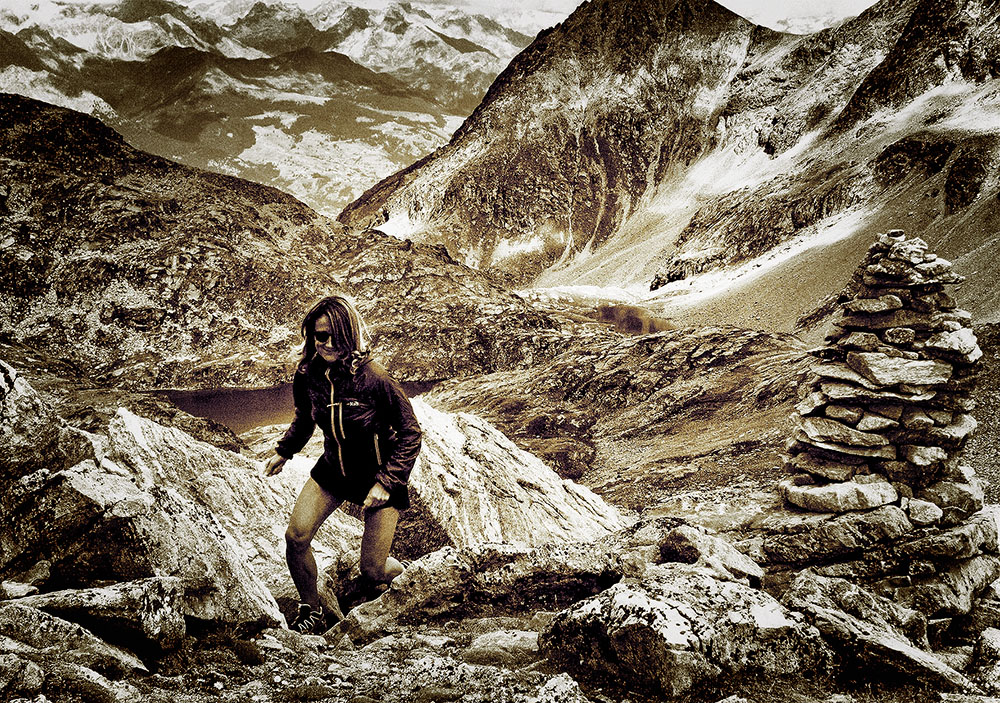
Aosta Valley, Italy. Photo by Maura Paillex on Unsplash.
In writing my book book Joyful Athlete, I found myself confronting a seemingly unbridgeable gap between scientific objectivity and materialism, and a mystical, devotional way of looking at the world.
I came at running from both ends, and for a long time I wasn’t aware of bridges between these two worlds.
I knew that religion — or rather, spirituality — can be useful and practical, and I had proved it on every level of my life, where prayer and meditation had delivered answers to an endless array of questions.
I came from a deeply rational background. In high school I’d been good at math and science, and in college I challenged every claim, accepting nothing that didn’t satisfy the demands of logic and reason.
I began running at the ripe age of 26. It was 1968. I was living in Southern California, taking classes at Long Beach State toward a teaching credential. I worked at the post office to pay the bills. I’d been paralyzed from the chest down for three years – a tumor was compressing my spinal cord – and was in poor physical shape.
Brother Bhaktananda, the most senior monastic of the Self-Realization Order, suggested that while my spiritual practice seemed fine, “The thought occurs that you might not be getting enough exercise.”
What did he mean? It was years before the “running boom.” In my free time I walked on the beach for hours, praying. The only people I saw exercising were college kids playing volleyball to the accompaniment of beer and loud music. Not really my bag.
I prayed for guidance, and at work the next morning, my supervisor, a retired Air Force colonel, walked up and pressed a book in my hands, his eyes gleaming. “George, you’ve got to read this book! It’s great — I’ve been on the program for six months and it’s done wonders for me.” It was Dr. Kenneth Cooper’s first book, Aerobics.
I bought a copy and began putting the system to the test. After reading several chapters, I went to the beach for a “Twelve-Minute Test.” As the first step in Aerobics, you run and walk as far as you can in 12 minutes. Based on the distance you cover, you’re assigned an exercise program appropriate to your fitness level.
Oops, I’d forgotten that I’d donated a pint of blood in the morning. Needless to say, my 12-minute result wasn’t impressive. But when I repeated it a couple of days later, I got the same result: “Poor.”
I wasn’t discouraged. The idea of getting in shape was deeply attractive, and Aerobics painted a rosy picture of what it would feel like to be fit. In any case, I knew that my soul wanted this, and I had a strong intuitive feeling that running would deliver rich rewards.
And it did. Running barefoot on the beach while the sun slid softly toward the horizon and seagulls glided over the surf, my heart would soar.
As the weeks and months passed, I found a new world opening within, the world of the fit and healthy body.
Often, while I ran, I felt a kinship in spirit with people who had lived thousands of years before and had run for the pure joy of it. During my best runs, my mind would fall silent, my heart would open, and I would find bliss.
Those fleeting moments were precious to me. I felt that they weren’t given to be enjoyed and lightly forgotten, but that they were openings to a connection with Spirit. I longed to learn to prolong them and experience them at will.
Ever the spiritual tinkerer, I tried to figure out the “system.” I thought that if I ran more or less the way I prayed and meditated, those higher experiences might happen more often.
I suppose it helped. But I was new on the spiritual path, and although I knew a little bit about prayer and meditation, I was absolutely unaware of the spirit in which they needed to be practiced.
It would be years before I was able to take the first halting steps toward acquiring the right spirit. Meanwhile, my experiments with “spiritual running” floundered.
I continued to have moments of harmony and joy, but they came randomly, outside of my control.
Most mystical traditions respect practicality and objectivity. They urge the student to test the claims of the scriptures and accept nothing on blind faith.
In my first years as a runner, I was frustrated by the endless discussions of training theory I found in books and magazines. The science of training held little appeal. I was more concerned with inner quality. Yet the longer I ran, the more I realized that even the best inner experiences were based on a certain order and method.
I began to notice that when I “got it right,” those elusive spiritual experiences came more often. I discovered that, as I had suspected, there were practical, objective steps that made those experiences easier to achieve. And the nature of those methods surprised me.
In 1971 I moved to Mill Valley, across the Golden Gate Bridge from San Francisco. That winter I saw an article in the San Francisco Chronicle about the 7.46-mile Bay to Breakers race, which was expected to draw – hold your breath! – as many as 2,000 runners. (The 2006 race had 60,000.)
I entered, finishing in mid-pack, and had a wonderful time. At registration the day before the race, I picked up a copy of Runner’s World, which the publisher was selling out of the trunk of his car.
I was powerfully attracted to the magazine, because I felt it spoke with the authentic voice of a runner. Later, I would realize that it was the voice of Joe Henderson, the editor, a wonderful man who viewed every runner as a friend.
Joe respected all those who were working to “stretch their edges” through running, whether they were overweight middle-aged joggers or Olympic champions.
I began donating my services to the magazine, translating articles from German and taking photos at races.
One evening, I got a call from Bob Anderson, the publisher, who said he wanted to use a photo of mine on the cover. I thought my heart would explode!
Bob said that the print I’d sent was too small, and they would need the negative. I jumped in my 1972 VW Bug and drove the 70 miles to Mountain View singing all the way.
I was still working at the post office, because none of the jobs for which I was qualified held the slightest appeal.
Carrying the mail didn’t seem like my life’s work, but it offered tremendous opportunities for fitness. Instead of driving door to door, I would load a big leather satchel to overflowing and double-time it, challenging myself to deliver to as many homes as possible with each load.
I calculated that in an average day I logged 12 miles of hard rambling. After work, three or four times a week, I would put on shorts and run eight miles out and back to San Anselmo. On Saturdays, I would drive to San Francisco and run 14-17 miles in Golden Gate Park and around Lake Merced. I was a fit young fellow.
In early 1972, Bob Anderson invited me to a party at the home of Natalie Cullimore, who had recently set a world record for running 100 miles on the roads (16:11:00).
At the party, Bob told me how he had started Runner’s World as a high school student in Kansas, printing it as a twice-yearly newsletter called Distance Running News on a $100 mimeograph machine in his bedroom. When Bob casually asked if I would be interested in working for the magazine, I immediately said yes.
Runner’s World was housed in a tiny industrial space in Mountain View, on the San Francisco Peninsula. There were three full-time employees, Bob, Joe, and I. Bob’s wife filled in part time, and a shipping clerk came in after school.
The magazine had just 5,000 subscribers and was printed in black and white. But it was growing rapidly, in sync with the jogging boom, which had received a powerful boost from Frank Shorter’s marathon victory at the 1972 Olympic Games. I remember watching Shorter’s race on TV and going for an exuberant celebratory run and seeing many other runners doing the same.
Working at RW was a mixed blessing. On the positive side, there was Joe, the magazine’s heart and soul. Joe’s cheerfulness and electric mind were a continual delight. On the other hand, no one at RW was the slightest bit interested in my peculiar spiritual slant on running.
Before I came to RW, running had been a personal quest. I had run to explore my limits and find my joy. Now, I was introduced to “scientific training” and “serious runners.”
There was so much to learn – so many theories about training, all propounded by people with far more experience than I.
I began to question how I should run, and as a result I lost touch with the simple instinct that had told me to find the sweet balance between effort and rest, and push the body slightly beyond.
My head spinning with half-baked ideas, I was forever uncertain if I was doing the single best, right thing.
Recalling my confusion at the time, I’m reminded of Joe Miller, a colorful Sufi teacher of the Sixties in San Francisco. A favorite saying of Joe’s was: “You can get more stinkin’ from thinkin’ than ya can from drinkin’ – but to FEEL is FOR REAL!”
After four years I left Runner’s World and moved to Ananda Village, in the foothills of the Sierra Nevada, 12 miles from the Gold Rush town of Nevada City, California.
By this time, running had become a burden. It actually seemed to be sapping my energy and making me irritable. I slogged on for several years, then gave it up.
I had enjoyed notably poor success in locating the wellsprings of spiritual bliss through running. Toward the end of the layoff, which stretched to eight years, I discovered that I had vitamin B and iron deficiencies, and that running had made the symptoms worse.
In the spring of 1988, while visiting friends in the Bay Area, I decided to take my camera to the famous Dipsea race, remembering how lovely it had been to photograph the runners on that gorgeous trail for Runner’s World.
I was, of course, completely deconditioned. I won’t describe my agonies as I waddled painfully up and down the hills. When I got home and showered, I stood before the full-length mirror and saw a fat, out-of-shape geezer. Clearly it was long past time to start giving the body its due again.
When I came back to running, my goal was the same as before: I wanted to learn to train well and find inner, spiritual communion.
But this time, starting over again as a complete beginner, I had better tools.
In my first “career” as a runner, I had approached the search with my natural instincts. Then I had adopted the prevailing emphasis on logical analysis. I had a superfluity of ideas, but I hadn’t understood that running well is as much about the heart as about logic and reason.
During the eight-year sabbatical, I had a conversation with Swami Kriyananda, during which I asked him how I could develop more love for God in my heart.
He replied, “That is your single greatest need. You should chant.”
In time, I took up chanting in full earnest. For a five-year period I chanted at least an hour and a half every day, never missing a day.
When we moved to the Ananda ashram in Atherton on the San Francisco Peninsula, I would jump in the car on Friday evening and drive around San Francisco Bay, 180 miles in three and a half hours, chanting all the way.
I had many wonderful experiences. Just as when I got fit for the first time in my life at 26, I now entered another entirely new world for the first time – the world of the heart’s feelings.
Now fat, out of shape, and no longer young, I decided that I would take a fresh approach. Whenever I needed answers in my running. I would do my part, using common sense and reason, but I would also consult the calm, intuitive voice of my heart and soul.
It would take 20 years, but in time I realized that the answer to “spiritual running” was simple. I remembered Gene Benvau, a direct disciple of Paramhansa Yogananda, who used to say with a chuckle, “The spiritual path is veeery simple – but that doesn’t mean it’s easy!”
That was my experience with intuitive running. I realized that the heart was Grand Central Station for many wonderful things. When we’re sick, we feel poorly, but when we’re hale and heart we feel wonderful. The heart’s feelings can also serve as a channel for guidance from an infallible, ever-loving higher source.
The problem isn’t that those feelings are complex; it’s that we’re often too distracted or willful to pay them much attention. It turned out that, while those feelings are always available and eager to help us, it takes strong, deliberate, focused attention, and disciplined perseverance and commitment to take them seriously and make a consistent practice of doing what they say.
That was 30 years ago. Did the experiment succeed? Of course.
In my book The Joyful Athlete I describe the science and philosophy of intuitive running and share stories of my experiences, as I unlocked the secrets of running well and finding joy within.