

Photo: Grateful thanks to Mohamed Rishfaan on Unsplash!
(Reading time 6.5 to 10 minutes)
God’s favorite tests are money, relationships, and tech. There’s another that older people encounter. It’s the need to start over.
The definition of a professional video camera is a box with a thousand buttons you can forget to press.
In my case, there’s no “can.” I’ve forgotten ’em all.
Then I make it worse. I get judgmental. “OMG, it’s awful. Not only have I made mistakes, if I don’t do it right I’m a horrible person who’s let God down shamefully.”
Life is a camera. There are so many buttons you can forget to push, so many dials you should have turned, and so much beauty to be captured when you get it right.
There’s a portrait painter I follow on YouTube. Chelsea Lang’s approach is alla prima – it means “with the first attempt.” She completes hundreds of paintings, one at a time, each at a single sitting.
She finds it’s the best way to improve her skills quickly, instead of dabbing at a single portrait for weeks, months, or years in search of an ever-receding perfection.
She paints beautifully, in the style of John Singer Sargent. She won an Oil Painters of America 2024 Gold Medal for her painting Make Believe. She works tirelessly and shares her methods generously.
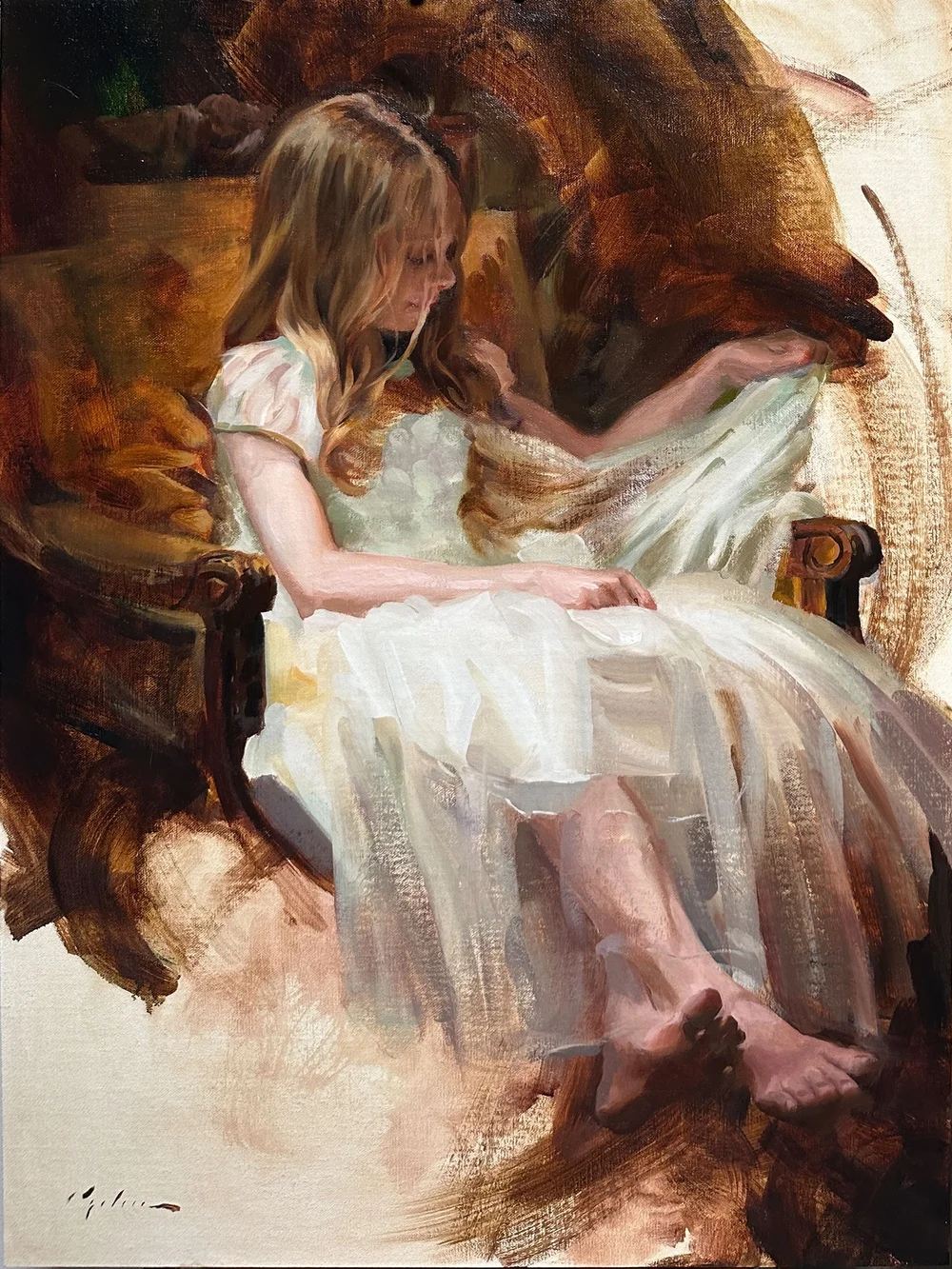
Make Believe, Chelsea Lang
In a YouTube video, she recalled her experiences trying to help older folks who had decided to take up painting after retiring from successful careers – and how most of them had a rough time.
They were so used to being at the top of their professions that it was painful to have to start all over again as beginners. Only a small portion were able to make the adjustment to taking one small step at a time.
I’ve faced that test with video.
It’s been hard to accept that I can’t leverage my six decades in photography. Nevertheless, I plow on. I show up at Sunday service, ready to shoot wonderful video of the singers. I think I’ve taken care of everything, only to find the camera behaving in a manner for which my years in photography haven’t prepared me.
Emotionally and spiritually, it’s hard. I’m so used to being on top of my gear, and it’s awful to feel that I’m letting God down with my mistakes.
Desperation breeds prayer. I reached a point where I could only throw up my hands and turn to God with exasperated honesty. I had to stop resisting, admit I’m a beginner, and ask for His help.
I remember how, in my first days at Ananda, Swami Kriyananda showed me a camera that he wanted to sell. He asked me many questions about it, and what strikes me is that he was instantly, effortlessly in beginner mode, simple, childlike, relaxed and completely focused. His humility was God’s humility; there was no thought of his own position in the mix, and whether he might look silly for asking beginner questions. When I told Nayaswami Asha about this memory, she said, “Yes, Swami was always willing to ask questions and learn. A good observation.”
Why on earth would I want to be a video beginner at age 84? Wouldn’t my time be better spent playing shuffleboard and doing Tai Chi in the park, then sitting on a sunny bench with my peers and kvetching about our old-guy lower backs and knees?
You got me. All I can say is that when I looked at the high-end, video-capable camera online, I got a warm feeling. It felt like guidance. I certainly had zero interest in competing with our Sangha’s very capable video crew, as I made abundantly clear to them.
But then I realized that it could be a useful adjunct to the work I was doing already, and that Swami Kriyananda had suggested to me on numerous occasions, of writing about Ananda.
In my work as a writer, I interview lots of people, and filming the interviews could be a simple way to provide additional value in an increasingly video-centric world. I had taken video of music and dance for the Ananda Garden YouTube channel, but the iPhone was better suited for that purpose, as it allowed me to shoot simply and unobtrusively, and the quality of the video and audio was fine.
At any rate, I continued to feel that I was on the right track, even as I struggled to learn the camera’s devilish quirks.
My mind drifts back to the mid-1990s when I worked at Master’s Market, a tiny grocery and health food store at Ananda Village.
I loved working at the market. I still feel it was my second-best job.
The best job was helping our lawyers defend Ananda against SRF’s massive lawsuit – it was special because we felt Yogananda’s blessings every day on our efforts to free his mission from narrow sectarian control. Also because of our lawyers, Naidhruva Rush and Jon Parsons. Naidhruva had a wonderful heart and was the soul of kindness and consideration. Jon was a delight with his humility, intelligence, and wonderful sense of humor.
My boss at Master’s Market, Tom Taylor, had served as a military policeman in the U.S. Marines. He was soft-spoken, humble, and tough.
I remember calling him on a freezing January morning with snow on the ground. I croaked, “Tom, I’ve got bad bronchitis and don’t think I can make it today.”
Without a trace of sentiment, Tom said, “We haven’t got a substitute.”
It happened twice. I would bundle up and stagger down to the market. Someone would hand me a cup of herbal tea, and within an hour or two I’d feel fine. I stopped calling in sick; instead, I showed up. I figured that if I passed out somebody would bring my limp body home, but of course it never happened; there was a grace in working for the Master’s cause, even in a simple job like serving at the market.
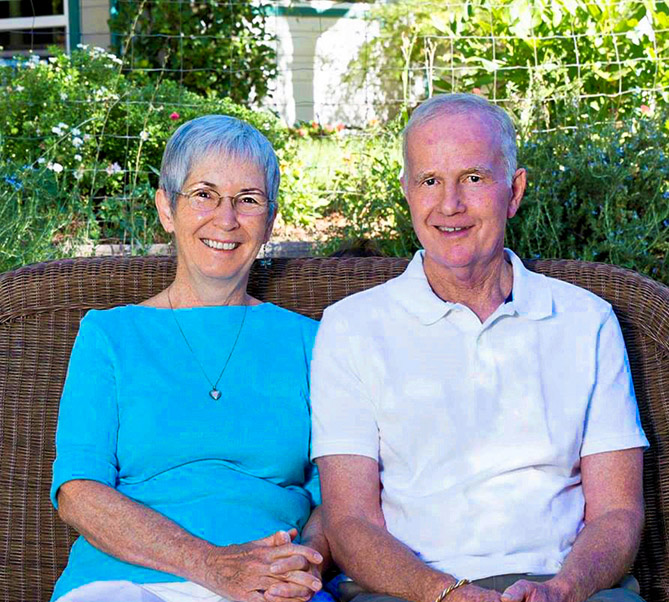
Tom and Sharon Taylor in 2015 at Ananda Village.
Tom told me that when he took over the market, he couldn’t stand the chore of stocking the shelves.
He said, “But then I changed my attitude. Instead of wasting time resenting that I had to stock the shelves, I started giving it my full, undivided attention. I would be completely focused on cleaning the shelf of dust and stains, then I would be totally focused on putting the cans on the shelf, making sure the labels were facing forward and the cans were in perfect lines.
“Before long, I realized that I was enjoying restocking and looking forward to it. I also discovered that being careful helped me be friendly and present when a customer would come in and ask if we carried a product, or if they needed help finding something.”
In my struggles with video, I reached a point where I had no choice but to be a beginner.
I was aware that someone had created a series of 79 videos on the features of my camera. I had figured out a few things, but now I patiently and enjoyably began going through the videos to fill the gaps.
While shooting test clips the next Sunday, I was able to take video of good quality that needed only a few adjustments to be excellent.
But then, human nature being a moron and a mugwump, clouds of doubts gathered and were soon blowing dark sheets of rain over me. “Oh my gosh,” I wailed. “This is nuts. We’ve come so far, and it’s still so complicated, and it’s been so expensive – and we still haven’t got it right!”
As these thoughts rolled over, I was sitting at the desk in my small home office.
I glanced at Master’s picture and saw that he wasn’t smiling as usual. Instead, he was staring straight at me with a matter-of-fact expression and level gaze. I felt the message, “Come on, Rambhakta. Take a moment to reflect and rejoice. You’ve had a great success!”
I remembered how I had felt on Sunday morning – how I’d been relaxed and happy and amused as I set up the video gear while reminding myself over and over to press the right buttons.
Then I received an email from Rita, who’s in charge of our healing prayer ministry. She asked me to find photos for a friend who was ill and wanted to connect with the inspiration of the Ananda community.
I sent Rita a link to an online folder of photos I’d taken over thirty years. As I browsed the folder, I saw that they had been inspired by God and Guru, and that it was they who had provided the energy, integrity, and light.
I realized I had all the encouragement I needed to march on, stop whining, and keep tapping the part of the universal consciousness that delights in overcoming doubts and tests and loves serving shoulder to shoulder with us even if it’s seldom easy and the results almost never seem as inspiring as they actually are, because Maya is always trying to throw shade on them and discourage us, even as we really are God’s angels.
Looking back, I see that everything beautiful has come with a fair amount of slogging.
Swami Kriyananda experienced this while writing the first edition of his autobiography, The Path. For months, he pushed on, never feeling his Guru’s blessing. But when he finished, he knew that the Master was very pleased.
I remembered how relaxed and happy I had been while setting up the camera. I was no longer letting the complexity overwhelm me, but being a beginner, enjoying the natural, unforced pace of the work.
Swami Kriyananda said that if we want to draw God’s love and joy and inspiration, we need to meditate with a heart that is harmonious and loving; then the mind will humbly follow.
It’s the same with tech – it comes along humbly when we are calm, happy, and patient. Software experts know this. Good engineers are patient problem-solvers. They know that frantic works against them.
The best engineers have beginner’s mind. They are calm and don’t get emotionally tangled with the tech. They patiently do what they can, one small step at a time. Because it works.
I’ve come to feel that it’s important to try to live in the happy, calm part of ourself that is already a wonderful child of God, filled with His goodwill – and to avoid the dark conflicted and confused lower part of ourself that isn’t our essence. Even if we can’t always stay in our highest self, it’s still the part that defines us. Everything else is smoke.
The image of “great” artists who are dark, tortured and conflicted is wrong. That kind of artist operates from the subconscious. The art world is awash in that kind of work, which may satisfy the artist’s ego if it’s beautifully crafted but helps no one except those who are subconscious, too, and mesmerized by craft and color.
It’s our old subconscious habits from the past that poison the well of our happiness. Swamiji said that Satan’s way is to try to discourage us and make us feel hopeless, whereas the guru may discipline us, but he always leaves us with hope.
Hopeful Thoughts
From Paramhansa Yogananda:
“Come out of your closed chamber of limitation. Breathe in the fresh air of vital thoughts. Exhale poisonous thoughts of discouragement, discontentment, or hopelessness. Never suggest to your mind human limitations of sickness, old age, or death, but constantly remind yourself, ‘I am the Infinite, which has become the body.’
“Take long mental walks on the path of self-confidence. Exercise with instruments of judgment, introspection, and initiative. Feast unstintingly on creative thinking within yourself and others.
“Above all, cultivate the habit of meditation. This is the inner switch you turn on to connect yourself with the Infinite. Hold on to the after-effects of meditation by your attention. You will then find that you are a reservoir of power in body, mind, and soul. By constantly holding in mind the peaceful after-effects of meditation, by feeling immortality in the body, and by feeling the ocean of God’s bliss beneath the changeable waves of experiences, the soul can find perpetual rejuvenation.
“You are all gods, if you only knew it. You must look within. Behind the wave of your consciousness is the sea of God’s presence. Claim your Divine Birthright. Awake, and you shall behold the glory of God.” From How to Awaken Your True Potential, part of the Wisdom of Paramhansa Yogananda series, Crystal Clarity Publishers
From Swami Kriyananda: Lightbearer by Nayaswami Asha:
After his class on Saturday, Swamiji said, “I woke up with the feeling that Master had something important to say through me today. I was so full of enthusiasm I didn’t have the patience even to meditate with the group, as I usually do before talking. It was as short as I could make it and still call it a meditation.”
The message Master wanted us to hear was simple: Be yourself. God has a special song to sing through each person. Get in tune with Him, ask Him who He wants you to be. Then with courage, creativity, and attunement, follow that superconscious call.
From St. Teresa of Avila:
“A meditation is well done even if all you did was fight distraction.”
From Keshava Betts:
Do stuff that helps you forget yourself – full immersion service where you enjoy it. You’ll find that your nerves will settle, you’ll find good thoughts, and your happiness will return. It’s the only way to think about it: I work for the Guru.
— Rambhakta