

Let’s find us some spiritual meaning in the popular arts! (Movie poster mashup by ChatGPT.)
(This is long, at 5,000-plus words, It’s also a bit of a muddle. I’ve long wanted to share with others what I’ve learned in the last sixty years about the meaning of life, and how to find guidance and inspiration on our path. I may not have found the clearest, most orderly way to share my findings, but for now, this is the best I can offer. I had fun researching and writing it. I hope you’ll enjoy it, too.)
“I am in the prime of my senility,” as Joel Chandler Harris said.
Why, then, I ask a breathless universe with which I am seamlessly entangled, has it fallen to my lot at this late stage in my life (I’m 84) to look for spiritual stirrings in the popular arts?
A great deal has changed in the arts in the last three hundred years. At the same time, much has also changed in religion.
The foundations of both systems, which were rigidly bolted together for 3,000 years, have suddenly been loosened, seemingly waiting to be reassembled in more fluidly meaningful forms, in keeping with the spirit of a dawning scientific age of energy-awareness, in which individual experience will count more than mindless conformity and unquestioning submission to institutional authority.
All of the significant inventions of the last century have been based on Albert Einstein’s discovery that the underlying substrate of creation isn’t matter, as the world believed for three thousand years, but energy.
Paramhansa Yogananda predicted that the new age of energy-awareness would bring sweeping changes to our work, our relationships, and in the arts and religion.
Yogananda said that he was born on Earth in response to a silent longing of many souls for a “practical religion.” He predicted that the demand for blind belief in religion would gradually give way to methods that would enable individual seekers to test God’s existence scientifically, using appropriate investigative tools of prayer and meditation in the laboratory of their own bodies, hearts, and minds.
Swami Kriyananda said that new spiritual movements always spread through the popular arts.
When I pondered Swamiji’s statement, I was baffled to understand how it would happen. In my mind, I had never associated popular art with spiritual inspiration.
Of course, there was art that explicitly included spiritual themes — the movie Gandhi, for example, or Handel’s Messiah, and Michelangelo’s Pietá. But Swamiji had referred to the popular arts, and none of those classics were sufficiently “popular” to fit the description.
When I asked to be shown what it might look like, I was guided to the movies — specifically, to two fairly recent popular films and an exceptionally well-crafted Canadian television series.
So far, well and good. But, I wondered, how can artists and, well, really all of us, find practical ways to draw inspiration from a higher spiritual source?
The answer is quite simple, even though, like any worthwhile endeavor, it’s bound to require a certain amount of mental focus, dynamic energy, and sweat and grit.
Still, I realized that knowing the meaning of life had been an immense help to me in my fifty-four years as a writer, editor, and photographer, and that one of the most helpful things I’d discovered is that it’s glorious to be aware of the Big Picture.
I don’t mean that, as a writer, I was obligated to memorize the big, fat Chicago Manual of Style, but that once we’ve discovered how the cosmos is constructed, how it operates, and how it’s arranged and what it all means, we find that we can leverage the system to our artistic and personal advantage. If you can peer at the world and understand what’s going on, you will never lack for inspiration, because you’ll find it everywhere.
Knowing the meaning of life is a great comfort – you know that it isn’t all just sludge, and that there’s a surefire direction that leads lawfully and inevitably to an inner exaltation of joy.
Knowing the big picture will help you find meaning and inspiration in the smallest things – in the details of your work, your relationships, in child rearing, science, and art. If you’re a creator, it will tell you the kind of art-making that will most fully satisfy your heart and soul.
Art exists on levels. Our ability to create meaningful art increases as our consciousness expands in the slow oven of many lifetimes.
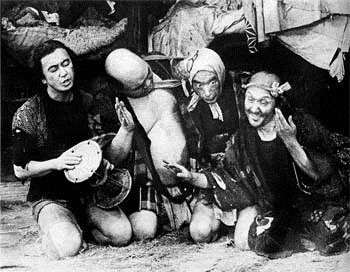 There’s art that’s centered around brute survival and base pleasures, and that aims to titillate the senses. Spiritually, it’s baby art – it’s largely boorish buffoonery. Like the poor wretches in Akira Kurosawa’s movie The Lower Depths (1957), which is based on Maxim Gorky’s play, sitting together and making rhythmic mouth sounds to entertain themselves. It’s very funny and humanly touching, but it doesn’t point to a path of expansion into the next-higher stage of awareness.
There’s art that is clever. It’s about negotiation, wheeling and dealing, and seeking happiness in outward rewards. I think of “I Am the Very Model of a Modern Major-General,” from the 1879 comic opera, The Pirates of Penzance by Gilbert and Sullivan. It’s pure infectious wordplay aimed at delighting a paying audience with its send-up of a general who’s not much of a military man, but the very model of a pretentious modern bureaucrat.
I am the very model of a modern Major-General,
I’ve information vegetable, animal, and mineral,
I know the kings of England, and I quote the fights historical
From Marathon to Waterloo, in order categorical;
I’m very well acquainted, too, with matters mathematical,
I understand equations, both the simple and quadratical,
About binomial theorem I’m teeming with a lot o’ news,
With many cheerful facts about the square of the hypotenuse.
I’m very good at integral and differential calculus;
I know the scientific names of beings animalculous:
In short, in matters vegetable, animal, and mineral,
I am the very model of a modern Major-General….
There’s art that turns cleverness in service to others – it wants to make people happy and rake in a few shekels while basking in their approval and praise.
There’s art-making that finds its pleasure in expansive feelings of kindness, compassion, and loving sacrifice – in doing what’s best for others, because it makes the artist’s heart feel expanded and free, while still hoping for a commensurate financial reward.
There’s a higher order of heartfelt art that is heroic. It’s about energy, courage, compassion, undaunted perseverance, intelligence, and self-offering in the pursuit of the happiness of all. Even at this level, though, there’s a lingering hope that the audience will at least show their appreciation for our efforts on their behalf.
Finally, there’s art that is infused with an inspiration that wants only to give, and that comes from a level of awareness that is beyond the reach of unenlightened hearts and minds.
It’s about a purity of love and wisdom that is barely imaginable from the perspective of our daily existence. It’s the life stories of Buddha, Jesus, Krishna, and Saint Francis. It’s a level of art that calls to us to seek the “something” we’ve longed for in countless lives, and that, once tasted, we realize we will do whatever it takes, for however long it may take, to get it for ourselves.
Paramhansa Yogananda said, “The caverns of many lives lie buried in your mental soil. All the desires you’ve ever had in the past are stored in them, waiting to attract you to material things. But if you go back to God, you will be able to satisfy all those desires forever in His bliss.”
For an exceptional experience of down-to-earth, very funny, spiritually uplifting Energy Age art, I can heartily recommend this wonderful performance of a play by Swami Kriyananda, The Jewel in the Lotus. (Due to technical difficulties at the start, the chanting is unusually long. To go straight to the opening scene, drag the play head forward to 16:30.)
What does God-inspired art feel like? At Easter, I attended a performance of “Christ Lives,” an oratorio composed by Swami Kriyananda.
As an effect of the music, there was a feeling in the hall of deep holiness. The musicians and singers performed angelically. I’ve rarely been so moved and inspired. (You can watch the video here.)
It’s the practice of the singers and musicians to meditate and pray before they perform. Before they arrive at the hall, they have asked God to bless them with the power to step aside from the ego and allow Him to use them to give the audience a taste of a happiness and freedom that each one can discover within, and that will relieve all their pain and suffering.
Years ago, after a performance of the oratorio at a Catholic church in Italy, someone remarked to one of the singers, “You all sang so beautifully – you must spend a long time practicing.”
The singer replied, “No, we hardly practiced at all.”
Later, Swami Kriyananda corrected her. He reminded her that the singers’ years of prayer and meditation were their most important practice.
There isn’t a lot of art that reaches such a level of inspiration. There’s a great deal of art and music from the past that feels holy because it speaks about God, but Christ Lives makes us feel that God Himself is inviting us to open our hearts to receive Him and commune with His joy through the music and bathe in His divine friendship and love.
What is spiritual art? Spirituality is about satisfying the universal human longing for happiness and freedom, a yearning that can only be fulfilled by expanding our awareness. All inner growth in awareness is spiritual, thus art can legitimately be called spiritual to the extent that it stimulates expansive aspirations and attitudes in our hearts.
This also means that art can be called spiritual if it inspires us, at our present level of awareness, to take the next step in our journey toward ultimate freedom.
In his book Out of the Labyrinth: For Those Who Want to Believe, But Can’t, Swami Kriyananda explains why values are relative, despite the insistence of religious fundamentalists and Church theologians that they are rigidly fixed and unchanging.
The answer is that values are demonstrably relative, but they are also directional.
Swami Kriyananda gives the example of a lazy slob who gets up one morning and puts on his least greasy shirt and goes out to look for work as a used car salesman. His friends all cheer him on, happy to see him taking a step toward greater inner freedom and happiness.
But if Mahatma Gandhi had decided to give up his life of selfless service, announcing that he was setting off to Calcutta to make a killing in rice futures, everyone would have exclaimed, “This man has fallen!”
Again, values are relative, but directional. Each action, thought, and feeling that expands our awareness, at our level, is spiritually nourishing – because it increases our inner sense of freedom and happiness.
This system makes a lot more sense than the old way, which assumed that we are all essentially the same, and that what counts is conformity to a rigid set of rules; whereas Directional Relativity allows for and encourages progressive development. This rings true with the longing in us that yearns to be more than we are, more healthy, loving, strong, wise, and happy, until, as Yogananda said, at last we merge in God’s endless joy.
The scriptures of India explain that we have five instruments through which we can find happiness and freedom from suffering: body, feelings, will, mind, and soul.
Of these five, the middle three – feeling, will, and mind – are the ones we can work with directly. The two instruments at the “ends” – body and soul – are outside the scope of our volition. The body, left to its own devices, just sits there, a lump. It’s essential to take care of the body in the spiritual life, because it provides the energy for our search. But we must apply feeling, will, and mind to keep it healthy.
At the other end of the spectrum, spirit is also beyond our reach. We can’t grab it and squeeze it for its bliss; we can only invite it to guide and bless us, as we grow in the understanding that Spirit alone exists, and that we are happiest when we bring its guidance into the smallest corners of our lives.
Yogananda’s most advanced disciple, Rajarshi Jankananda, said, “I have come to understand that one-hundred percent of the spiritual path is receptivity.”
Our happiness and freedom increase as we “get more” by using our tools expansively – when we get more health, love, strength, wisdom, and joy. Thus, the stories that tend to inspire us the most are about people who face difficult tests, obstacles, and suffering, and who overcome them and grow larger than they were.
Consider the Mel Gibson movie, What Women Want. Gibson plays an advertising executive who uses women cynically, but he can’t write ads for women to save his life, because he doesn’t understand them.
Then a hair dryer falls in his bathwater, shocking him into unconsciousness, and when he awakens, he finds that he can hear what women are thinking. At first, he uses the gift in his usual cynical way, but in time he develops compassion for women and begins to expand his heart in kindness, finding happiness in helping them. By expanding his awareness to include the realities of others, he discovers a happiness of a higher, more satisfying kind, and as a result he becomes a better man.
What Women Want grossed $374 million worldwide against a $70 million investment. Not a bad result, for a flick that strung an amusing plot on a framework of spiritual values.
The scriptures of the East tell us that we grow in spiritual awareness in four stages, each of which requires many incarnations to learn its lessons fully, as we gain the inner strength, understanding, and awareness to proceed to the next stage.
The first stage is called the Sudra, in which our consuming concerns are about base pleasures and survival – food, shelter, procreation. At this stage, no real spiritual aspiration is possible – we can only learn from brute experience, the way a rat learns to find food in a maze by receiving a shock at the end of one path, and food at the end of another.
Very gradually, we learn that by applying a bit of energy and cleverness, we can improve our circumstances. Now we’ve entered the Vaishya stage, which is symbolized by the wheeler-dealer merchant.
Spiritually aspiring people tend to look down their noses at Vaishya consciousness, imagining bandits and thieves, eager to cheat and take from others for their own advantage. And while this may be true of the first stages of our long Vaishya sojourn, the latter Vaishya stages hold important, even genuinely inspiring spiritual lessons.
At the higher levels of Vaishya Dharma, we begin to discover happiness in caring for others. Our awareness expands as we experience the rewards of turning our hard-won Vaishya strengths of courage, mental focus, worldly know-how, and self-control to the service of family, friends, community, and country.
Yet the Vaishya world also reflects Paramhansa Yogananda’s wry comment that the trouble with this human existence is that it “almost works.”
Even in the higher Vaishya stages, we are still looking for fulfillment outside ourselves, in possessions, status, respect, and the love and approval of others.
During our Vaishya lives, the universe tries to help us understand that we can never find true satisfaction by seeking it at the expense of others, or by satisfying our desire for material things.
Until we awaken to this realization, Vaishya existence is mosquitoes at the picnic, and sunburn and sand between the silk sheets. Until we gain the karma to be awakened to the next level of awareness, God will let us experience the discomforts and disappointments of our lesser ways.
The Vaishya life is fraught with aggravations, discomforts, broken hopes, frustrations, anguishing pains, a horrifying sense of meaninglessness, and colossal barriers of bafflement.
At this point in our long spiritual adventure, Life Itself tries to get us to wake up, pay attention, and pause and reflect.
Until we give up hope of finding fulfillment anywhere but in God, He won’t shirk from letting us experience the results of our misunderstanding.
God isn’t a sadist; He wants us to grow in happiness and freedom. Paramhansa Yogananda, whose consciousness was merged in God, said, “I wish to influence others only by love. I just wilt when I am forced to train them in other ways.”
The next step in the expansion of our hearts is the Kshatriya – the stage symbolized by the spiritual warrior. We enter the Kshatriya stage when we’ve become sufficiently aware of the superior satisfactions of living for others – thus the Kshatriya is symbolized not only by the warrior who gives his life for others, but by anyone who holds their fate in his hands and is motivated to help them, rather than use them for his own selfish ends.
Eventually – and it always takes a very long time – we realize that we can provide the greatest service to others by offering our lives, body, heart, will, mind, and soul, entirely to God, in the awareness that He alone knows what people truly need, and that He alone can help them.
What is God’s joy like? Years ago, I attended a talk by a disciple of a great Indian saint, Sri Ramana Maharshi. Ramana had given his disciple the name Sunyata, or Shunyabhai, which means “Brother Zero,” signifying that he had emptied himself of ego and God had filled Him with His bliss. Shunyabhai would give a talk at The Expanding Light guest retreat at Ananda Village.
We arrived early, and as we waited, I noticed a number of unfamiliar faces. I thought cynically, “Yeah, these old ladies always show up when there’s a spiritual celebrity in town, but they’re never here when it’s just meditation as usual.” As my eyes scanned the crowd, I noticed one of the old ladies peering in my direction and chuckling softly.
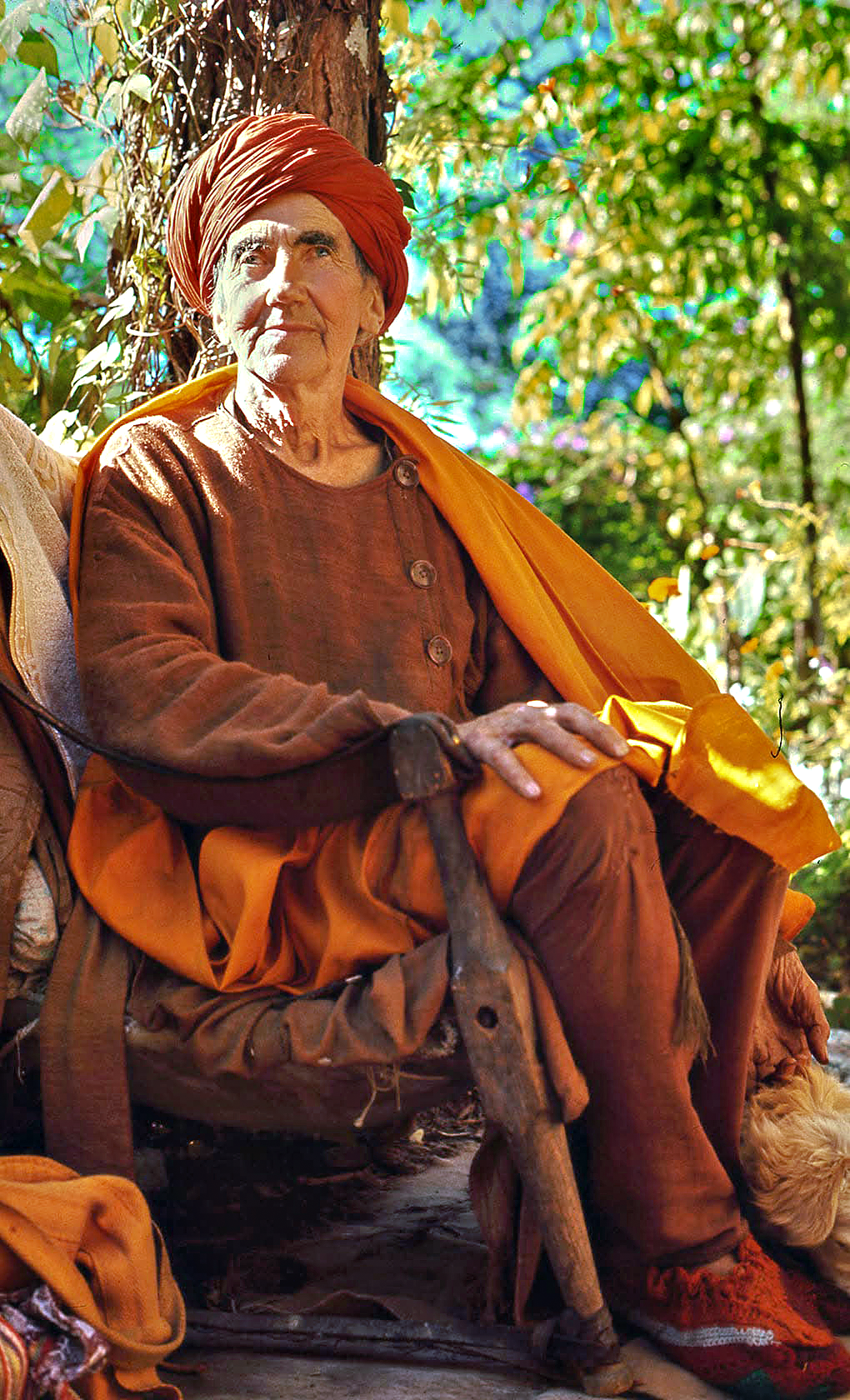 After the introductions, the Ananda minister invited Shunyabhai to come forward. Although he was ninety-three, he leapt to his feet and bounced happily onto the stage like a little child. As you’ve doubtless guessed, it was the “old lady” who had responded to my silent criticism with an amused chuckle.
No sooner had Shunyabhai begun to speak than there was a wave of such powerful, soul-penetrating joy emanating from him that it made us gasp. I realized that that joy held everything I had been seeking in all my countless lives, and that, as I hinted earlier, I would do whatever it took, for however long it might take, to get it for myself.
I have never experienced the same degree of joy on any other occasion in this life. And, for a time, I wondered why.
On this and other occasions, I was blessed to receive inspiration such as I never received directly from Swami Kriyananda or Paramhansa Yogananda. Naturally, I’ve pondered why this was so, and in time I arrived at an answer that makes sense to me.
Oh my, what a can of worms I’ve opened. Should I have kept my mouth shut? On the other hand, there can be no profit in hiding from reality, and for those who walk the path of Self-Realization in this life, it simply isn’t possible to escape the fact that our lives, like Swami Kriyananda’s are, as Paramhansa Yogananda told him, about “service — plus meditation,” and not the other way round.
First, I take comfort that Swami Kriyananda had the same experience with his own Guru, and that many at Ananda have had the same experience, too.
I want to say, with the utmost emphasis, that I am certain that it was my own gurus through whom the Divine arranged for me to have those experiences, to show me what was at stake in the spiritual life, and encourage me to keep going. As Paramhansa Yogananda said, after we have taken Kriya Yoga initiation, everything that happens in our lives is by the Guru’s grace.
If they had given me those experiences directly, I would have been less open to their encouragement to serve their mission, and I would doubtless have pestered them for a shortcut to that bliss, which would not have been in my spiritual best interests. My attunement might have been weakened, and my volition might have been less focused on the lessons at hand.
I remember how, for years at the start of my spiritual journey, I firmly believed that those high experiences were the whole point of the spiritual life, and that all of our efforts and attention in prayer and meditation should be directed toward finding our way into that high and blissful, desireless state. In 1966, when I was twenty-four, I had an experience of spiritual awakening, where my ego shrank to nothing and I experienced myself as nothing but a tiny spark of God’s infinite consciousness. But in the end, again, I had to conclude that, no, those experiences are not the whole point of the path; not even close. Nor do they, even remotely, completely define its fulfilments.
As Paramhansa Yogananda said, we should not seek God for His miracles. He said, again, that the spiritual path is not a circus. In the end, I have found God and Guru most assuredly with me while I am doing the work that they explicitly asked me to do. In my case, for example, Swamiji repeatedly suggested that I write about Ananda, and about our path, and how it offers the sure answer to every question and will lead us inevitably to happiness and freedom from suffering.
I remember something that Nayaswami Seva told me in 1976, my first year at Ananda Village. I said to her, “Wouldn’t it be good if we could emphasize devotion more in our life at Ananda?”
She answered with exaggerated exasperation, “Rambhaaaktaaa, we’re here to build this work! It’s only for this one lifetime.”
I had tremendous respect for Seva, and I took her answer seriously.
In time, and it took a while, I wised-up and realized that whenever I served the work in harmony with Swamiji’s direct or intuitively perceived guidance, I thrived spiritually. And when I look at the lives of those who’ve given their all in service to God and Guru, I see that they are soaring in God, and it only makes me wish I had wised-up sooner.
I’ve also seen people come to Ananda, eager to find God in meditation, but who balk when the time invariably comes that God turns off the spigot and waits for them to recognize the need to serve. If they continue to resist, I’ve seen how they can become grumpy, set in their ways, and then too often judgmental with a smidgeon of holier-than-thou thrown in, which was a sure sign that they would shortly slip out the door and continue their search elsewhere.
That said, I’m not complaining, because I feel God, Guru, and Swamiji guiding my life every day, to the extent that I offer myself dynamically to do their will.
In the beginning of my spiritual search, I was intent on finding God’s bliss in solitary meditation. But God made sure that I wouldn’t be able to find Him by pursuing the life of a meditating hermit. He made it abundantly clear that one of my greatest needs in this lifetime was to understand the supreme, imperative need to expand my heart and my consciousness through service.
Eventually, I realized that if He had given me the bliss I longed for, I would never have given much attention to service, and I would not have learned the spiritual lessons it was intended to teach me.
I’ve explained elsewhere how God further clarified my path by paralyzing me from the chest down for three years, with two surgeries that left my spinal X-ray looking like a dog’s hind leg, which has made deep meditation impossible.
I’ve spoken elsewhere also of how Swami Kriyananda and Swami Vivekananda were separately commissioned by God, through their gurus, to spread the liberating message of Self-Realization in the West. In each case, the guru told the disciple that the awareness of their status as Self-realized masters, or jivanmuktas, freed souls, would be temporarily cloaked so that they could complete their outward mission.
Swami Kriyananda said that he believed many souls at Ananda had known high spiritual states in former lives that were being hidden from them this time around, so that they could discover the joys of inner expansion through outward service.
The name, Kriyananda, means divine bliss through action, or service. Yogananda told his beloved disciple that God would not be fully revealed to him until the end of his life, and that death would be the final sacrifice he would have to make.
Swamiji served with near-unbelievable heroism, in a body that should have died decades before his actual passing. The story is told beautifully in Swami Kriyananda: Lightbearer, by Asha Nayaswami.
Two separate ancient books of prophecy in India foretold that Swamiji would find final liberation, moksha, at the end of this life.
The point I take from this is that service is not a secondary, auxiliary, or lesser aspect of the path; it is absolutely essential, and can be a path to liberation.
But I’ve strayed from my point, which is about finding spiritual themes at the movies.
When great masters come into the world to remind us of the perfect fulfillment we can find within, it’s exciting to discover that as we follow their guidance, we begin to discover spiritual themes hiding in countless ordinary and mundane, even seemingly unspiritual places.
Let’s look at some examples. We’ll go back to the movies.
Be warned: we’ll consider another film and a television series that we would never remotely dream of recommending to our fellow seekers. In fact, I don’t recommend that you watch them. I believe I was led to them by my Guru, in answer to my silent desire to understand how spiritual themes can be woven into the popular arts. In the process, I found spiritual messages hiding in unlikely places.
Goon is a deeply profane film about a young Jewish man in Canada who has a special talent for fist-fighting and is recruited to join a minor league hockey team to serve as its punisher, hence the title of the film.
There’s an amusing scene early in the movie – spoiler alert! – but then I’ve urged you not to watch the film – where Doug Glatt stands outside the temple with his parents and their friends.
The Jewish parents are bragging about their children’s successes. “My son’s a neurosurgeon with a big practice in Toronto.” My daughter’s a junior partner at a big legal firm in Montreal.” When they’ve exhausted the material, one of them turns to Doug and says, “Well now, Dougie, what are you up to these days?” Whereupon Doug smiles broadly and says, “I bounce.” The camera then pans to the curb, where Doug’s gay brother hops out of a small red sports car after giving his boyfriend a peck on the cheek. Imagine the poor Vaishya parents’ humiliation.
The spiritual theme of the movie is simple: Doug is a doofus, but he has a great big heart. He’s fiercely loyal to his teammates, even though they rib him mercilessly as they watch his first attempts to skate. Which inspires Doug to deliver a beat-down on every one of his new teammates, to the delight of their coach, who figures he’s found the right lad for the enforcer’s job.
The point of the movie is that a good heart can compensate for great failings. It’s reflected in a sweet song, “Work With What You Got,” that plays over the end credits, and that I heartily recommend listening to.
An interesting thing about another Canadian product, the TV series Intelligence, is that most of the characters are given equal weight. It’s as if the screenwriter, Chris Haddock, valued his characters’ humanity and respected their struggles, each at his level.
Swami Kriyananda said of P. G. Wodehouse, the English humorist, that he had a quality of all great artists, in that he never wrote-off his minor characters or sped through a minor scene – he always gave them his full, focused attention and energy, however fleeting and utilitarian their roles. Thus, waiters, cab drivers, servants, and other passing players received the same robust energy from Wodehouse’s pen.
In Intelligence, Chris Haddock makes even the shabby murder-for-hire couple that Mike pays to kill a traitor in Mexico City seem very much as we would picture them – gray, soulless people – not in order to stimulate dark feelings of contempt in us, as lesser hack TV writers might do, but to reveal them as sad people with no possible happy future, in whom the gravity of their crimes weighs forlornly.
What sets Intelligence apart is its amazingly well-drawn depiction of people living the Vaishya life with varying degrees of awareness.
Want an exciting life among criminals? If so, you’d better be ready to keep yourself tensed to the point of emotional exhaustion and imminent mental disarray to fend off the waves of people who are just like you and will want to take what you have.
What to speak of the emotionally exhausting characters you’ll have to deal with in wheeler-dealer land, most fleshily illustrated in Intelligence by Jimmy Reardon’s thoroughly unbalanced wife, Francine, and his dangerously google-eyed brother, Mike. I wonder if there are any other modern artistic depictions that portray Vaishya existence with as much piercing clarity.
A leading Canadian reviewer called Intelligence “superb TV” and lambasted the Canadian federal arts commission for omitting it from awards consideration, and for eventually shutting off its funding. Intelligence was so realistic that the government feared it would remind viewers of recent scandals and make them seem more credible.
Dramatic works deal with extremes, and Intelligence is embedded in a Vaishya culture where the prime directive is to look out for number one, to the extent of smuggling enormous quantities of marijuana, ordering the murder of enemies, and operating out of strip clubs. If the series has a redeeming feature, it’s that it portrays Vaishya Dharma with such amazing accuracy.
In Intelligence, Mary Spaulding is the female lead, wonderfully played by Klea Scott. Mary has come a long way toward embracing Kshatriya values – she’s adept at using her hard-won wheeler-dealer Vaishya skills in service to her goal of leading the Pacific division of Canada’s anti-drug intelligence service.
Meanwhile, Jimmy Reardon, Mary’s opposite, is a Vancouver marijuana kingpin who has mastered the Vaishya dance and has begun to dream of exchanging the exhausting wheeler-dealer grind for a less stressful and more expansive existence. In short, Jimmy wants to love.
Swami Kriyananda said that it is good for people of lesser understanding to spend time with those who are living on the next level of spiritual awareness. In Intelligence it’s obvious that Jimmy Reardon secretly admires Mary and would like to be more like her, if he could break out of his entanglement with the Vaishya life.
Mary even rubs off on Ted, her sneaking, treacherous co-worker in the drug squad. In the end, Ted realizes how exhaustingly his scheming ways are wearing on him, and as his eyes open to Mary’s essential decency and higher aspirations, he changes and gives her his whole-hearted support.
Ronnie Delmonico, Jimmy’s partner, is an entrenched wheeler-dealer who has no wish to leave “the life.” Ronnie warns Jimmy that if he doesn’t keep his head in the game, he will be devoured.
Let me note, first, how much I love Paramhansa Yogananda and Swami Kriyananda’s portrayal of spiritual development as directional.
Spiritual progress isn’t accomplished in a single swooping descent of random grace, or by an all-out, gut-busting effort at self-transcendence on our part that squeezes the ego out of us and makes space for enlightenment to flow in. It’s a question of individual, internal growth over a very long time, and we should be grateful and proud if we’re doing our best to move forward in the right direction at exactly the point where our nature has brought us thus far in our journey.
As Swami Kriyananda said, the spiritual path is not about waiting for the Guru to come and make things right; it is about dynamic self-offering. It takes a rare degree of clarity of heart not only to give ourselves dynamically to the Guru and his cause, but to want with the deepest inner love of our hearts to do so.
Until then, as Swamiji often urged us, we must work with ourselves as we are. In Out of the Labyrinth, he says that we should never give something up until we know, “with a sure inner knowing,” that we want something higher.
(In a separate article, “Plain Talk About Art, Spirit, and the Merchant Caste, I include passages from the book The Hindu Way of Awakening, where Swamiji describes the inspiring spiritual lessons of the higher stages of Vaishya Dharma.)
Suffice it to say that I took immense pleasure from finding Vaishya values so wonderfully portrayed in Chris Haddock’s masterful script.
Levels of Revelation at the Flicks
In truth, the most spiritually valuable films don’t cater to perverted tastes or merely tickle our nerves. They are based, to varying extent, on expansive themes. By “spiritual” and “expansive” I mean that people love a movie where the characters endure hard tests, learn difficult lessons, and become more loving, compassionate, strong, and kind as a result. A cynical exec learns to empathize with women, and as a result he becomes a better man.
Why don’t movie producers understand this? I blame the grotesque confusion over values today.
It takes hundreds, if not thousands of people – executives, directors, cast, crew, artists, technicians – to make a major Hollywood movie. Nonetheless, when a sufficient number of basically decent people come together to make a warm-hearted film, the experience can be magical, and the profits tend to roll in.
Witness the documentary Never Surrender, about the making of Galaxy Quest, one of Dreamworks’ first films. The American playwright and author David Mamet considered Galaxy Quest one of just four perfect movies – the others were Dodsworth, A Place in the Sun, and The Godfather.
The actors, execs, and creatives on Galaxy Quest were likeable, earthy folks, and the heavens aligned magically to bring them together to make a movie that expressed their values.
Here’s another point to consider. If you’re an artist, and you’re wondering how to turn your work in an expansive direction that will attract an audience and fill your heart, you needn’t look far. As I hinted earlier, you just need to know how life works, and you’ll never run out of ideas.
At this point in the long, unfolding saga of world history, you won’t have to confine yourself to following the specifications of a guy in red pajamas who has the power to burn you at the stake if he doesn’t like your art. (Please watch this Monty Python Michelangelo sketch.)
Still, people do put fences around the higher stages of spiritual evolution. If art isn’t created from the level of Kshatriya and Brahmin consciousness, they feel it can’t possibly be “spiritual.”
In the early years at Ananda Village, I worked in the Publications office, where our crew consisted of thirteen nuns and two men, Binay Preston and yours truly. The nuns pretty much ran the community. (Swami Kriyananda said of the convent, “There are some tough babies there!”) They also set the standard for what was considered “spiritual” in the arts.
I remember a particularly forceful nun warning me not to watch the Dustin Hoffman movie Tootsie which was playing in town. There was urgency in her plea – clearly, she wanted to save me from becoming a transvestite and losing my soul in fathomless perdition.
There was a feeling in the community at the time that unless a film was called Mickey Mouse and Donald Duck Play Croquet and Have a Tea Party, it posed a danger to our souls.
I remember watching the film The Prime of Miss Jean Brodie (1969), in which an eccentric teacher, played by Maggie Smith, talks in highly romanticized terms to her young female students about the civil war in Spain, as a result of which one of her girls runs off to join her brother in the war, only to be killed when her train is attacked and bombed.
I told friends that I had found the film spiritually inspiring, which is how I still feel about it.
Shortly before I saw the movie, Swami Kriyananda had remarked that it is better to have high energy and strong willpower in the spiritual life, than to be a weak-willed, docile, nice devotee.
I felt that Jean Brodie fit the description: she brought her full energy to her convictions, however dangerously unrealistic, and as a result she was given the opportunity to learn a hard spiritual lesson by being confronted with the terrible consequences of her ill-considered words.
My friends duly watched the film and were dismayed. “What were you thinking, Rambhakta! That wasn’t at all a spiritual movie in any way we could imagine.”
It was tragedy in the classical sense of a person of exceptional energy and a great deal of goodness who suffers from a serious flaw and must experience its terrible consequences in order to learn and be purified and freed.
I’ve told elsewhere how Swamiji would go along with us to see a questionable movie, if he felt it held a spiritual lesson for us. I remember how he sat through the Dustin Hoffman thriller Marathon Man with a group of us from Ananda Village, and how, when one of the nuns closed her eyes during a torture scene, Swamiji told her that she shouldn’t hide from unpleasant realities, but learn to face them squarely, with calm detachment.
Nevertheless, he would cheerfully walk out of a movie after five minutes if he realized that it was trash and held no useful message.
Paramahansa Yogananda was born to show the world that spiritual progress is directional, and that anything that helps us ascend to higher awareness, starting where we are and taking one brave step at a time, is “spiritual,” in the context of our own growth.
It was an insight that he brought as a correction to older modes of thinking.
“If you go dancing and drinking, you will burn in hell for all eternity!”
“Why?”
“Because Jesus loves you!”
Kali Yuga theology reflects the rigidity and intolerance of human consciousness in an Age of Matter. It has nothing to do with Jesus’ teachings, which at their simple core urge us to love one another, and proclaim that God is our dearest loving Father and Friend.
Yogananda declared that it’s time we learn to see Spirit active everywhere.
If we want to make spiritually uplifting art in this dawning age of Energy Awareness, which the sages of India called Dwapara Yuga, we will have to show how our art relates meaningfully to people’s everyday lives. And because Dwapara is weighted toward Vaishya consciousness, we may not be able to communicate spiritual values in their purest form to the masses – but we can express expansive values through art in ways that people can understand and relate to.
It may mean that we won’t be able to reach the masses with art that expresses angelic values. But we can tell uplifting stories about merchants, soldiers, farmers, bankers, lawyers, and even criminals that illustrate spiritual principles.
We can study how spiritual themes have carried inspiration in Vaishya art already, in music, books, painting, films, architecture, drama, and sculpture.
At the same time, what could be more obvious than that there will always be a role for churches, temples, and monasteries where the art is limited to that which explicitly encourages our highest aspirations. Or that there will be a ready market among people of expanded, but not yet fully freed consciousness, who will be receptive to refined art that inspires them to expand their awareness at their level with its lofty themes.
If we want to create art that will inspire the masses and give them hope and meaning, we will have to make sure it calls to them from their own next level of growth. Television series like Intelligence won’t find an audience in the monasteries, but they’ll hold lessons for people who want to understand the rewards and risks of the Vaishya life, or who are ready to be inspired by characters like Mary Spaulding, who have taken the first steps into Kshatriya consciousness.
The world in Dwapara will need lots of stories about heroes. It will need art that shows how spiritual principles of kindness, compassion, cooperation, honesty, inner strength, focus, steadfastness, and spiritual truth can bring us success and happiness.
We’re fortunate to have such films, television series, and books already – not many, but enough to offer a foretaste of what’s to come.
Books
Out of the Labyrinth: For Those Who Want to Believe, But Can’t
You truly are truly amazing, Rambhakta; and I feel so blessed to have access to your wise & insight full writings. Always revealing & delightfully encouraging!
Well, gee, Atmajyoti, your words aren’t at all hard on the ears. But frankly I have to take a step back and, in all truth, give credit for the good parts to Swamiji. In this case, at least, I have to say that I really had to walk my talk – looking for inspiration somewhere outside a cerebellum that wasn’t nearly up to the task. Those movies! Golly, Swami does have fun with us! In any case, thank you very much for your kind thoughts. All blessings to you.
I, too, value your insightful and very creative offerings, Rambhakta. Keep keeping us on our toes!
Helen
Thank you, Helen. I’m looking forward to reading your book on the Education for Life miracle – your wonderful stories from a half-century (or longer) of delivering an education that puts an afterburner on children’s happiness, life success, and achievement. Education for Life holds tremendous value for adults who don’t even have children, because it reveals the meaning of life and how we can educate OURSELVES for the greatest happiness and success. So many wonderful conversations over the years – it’s been a joy!