
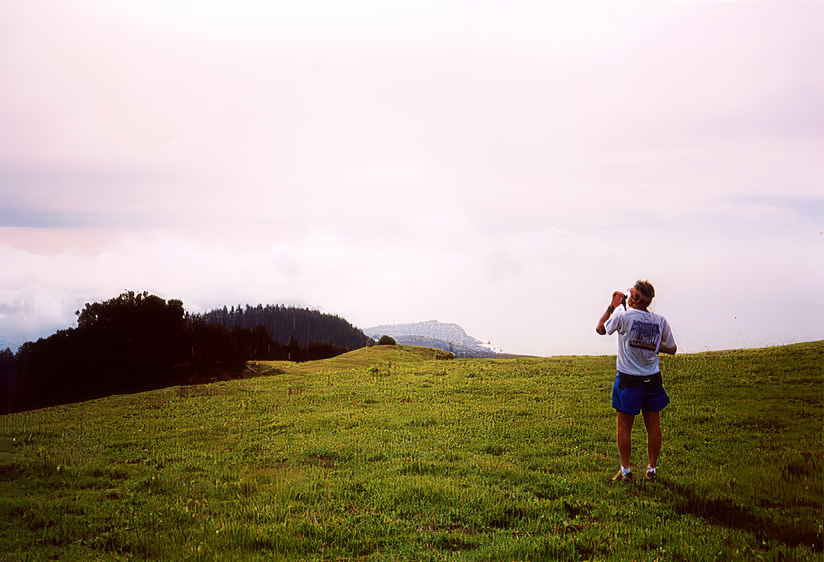
The author pauses for a potion and a panorama on Mt. Tam in his former fit and durable body.
This is Part 1 of a two-part series on recovery. The second article will include a continually expanding list of practical tips for shortening recovery time; e.g., actual experiences with dietary changes, supplements, non-running recovery days, etc. I might not post Part 2, if I decide that the content doesn’t blend well with Ananda Garden.
When I began running ultramarathons, I took a subscription to Ultrarunning magazine and, almost immediately, groaned with despair.
Looking at the race results, I saw the names of the same runners month after month. Who were these super-runners who could race 30 to 50 miles every two or three weeks without destroying themselves? When I tried it — I ran seven marathons and three 50Ks in seven months without reducing my regular training — I crashed badly. Then I discovered the frequent-flyer ultrarunners’ little-known secret.
I was running a tough double-marathon, the 1994 Sierra Nevada Endurance Run, climbing a steep hill, when I fell in beside Suzi Cope, a well-known ultrarunner who ran prodigious numbers of races; at the time, Suzi had run more ultra races than any other female. I said, “You’re able to run such amazing numbers of races. How in the world do you train?”
She said, “I don’t. I just run ultras.”
The secret was out. The every-week-another-ultra crowd simply give their bodies tremendous amounts of rest, corresponding to the length of their races.
Like Mark Twain, who said that giving up smoking is easy — “I’ve done it a thousand times” — I learned about the importance of recovery the hard way.
“Think It Over”
After six weeks of hard speedwork, stair-running at Stanford stadium, and mega-weight workouts — no surprise, I got injured. But the layoff proved a blessing, because it gave me time to reflect on my goals.
Could I run without trashing my life? I was weary of mismanaged training. I longed for balance and harmony.
I prayed for guidance, and the next day I stumbled across a message I’d saved on the computer years earlier.
It was from Eric, an ultramarathoner who ran amazing numbers of races. I once asked him how he managed to race so often. He laughed and said he would sign up for so many races, he’d often forget which one he was supposed to run that weekend, and he’d have to consult the spreadsheet where he logged his entries.
Eric told me he trained very little, yet he raced well, and he’d finished nearly all the major US 100-mile trail races, including Hardrock, the most difficult of all.
(Just for fun, here’s the official Hardrock course description: “The 100-mile race in Silverton CO in early-mid July has 33,000 ft. of climb at an altitude of 7700 to 14,048 ft with 11 mountain passes above 12,000 ft. Cutoff is 48 hours. Terrain is mostly trail, scree, snow, and tundra with many river crossings. Parts of the course are climbed with ropes on scree or snow at a 45-degree slope. Some night sections traverse the edges of cliffs dropping hundreds of feet. Altitude sickness and pulmonary edema are common among competitors. Weather: 15 F to 85 F with afternoon hailstorms and lightning possible.”)
In his message, Eric credited his success to putting all his effort into the training runs that counted. For an ultrarunner, that means the weekend long run, which for him, was usually a race.
Eric told me he might do several fast quarter-mile repeats on the track at midweek, but nothing else. He was essentially running just one day a week, but it was often a 30- to 50-miler.
It was good training for an ultrarunner — though it might not work as well for a 10K specialist or marathoner.
On the other hand, former US Olympian Jeff Galloway coached more than 200,000 runners to complete their first marathon. His advice? Do no more than an hour of running, total, during the week. Save all your energy for the weekend long run.
Eric’s Reflections
My most aggressive mileage ramping occurred a couple years ago when my long run went from zero to one hundred in less than six months. I believe that it succeeded because of the massive amounts of rest I got between runs (i.e., in 23 weeks, I ran only 36 times).
I started out trying to run at least two or three times per week, because at the time I believed that was the minimum for any training schedule. I started to make real progress when I abandoned this idea (week 8), and decided to run only once per week unless I felt exceptionally strong.
Yesterday’s run drove home the lesson about harmonious training. During the week I had let my body become dehydrated, and when Saturday rolled around I was feeling deeply wasted. Nevertheless, I was eager to begin my new training plan, so I forged ahead and ran 4½ hours in the Marin Headlands.
I set out from Tennessee Valley and wandered along the Coastal Trail to Muir Beach and Muir Woods, then trotted up the Dipsea Trail to Cardiac Hill. Arriving at the top, I stumbled off the trail and sat on a rock, knackered and limply debating whether to press on to Stinson Beach or turn around.
A young runner came loping up the Dipsea, and when he saw me he walked over to share the view, which was gorgeous. From Cardiac you can see 15 miles north to Point Reyes, 15 miles south to Pacifica, and 20 miles west to the Farallon Islands.
The runner said he’d cycled up Mt. Tamalpais that morning, and I asked if he was a triathlete. He said yes, and volunteered that he’d recently hired a personal trainer who told him to put 99 percent of his energy into the workouts that really matter, and that if he felt tired, he should simply skip the shorter “recovery” runs.
The universe had spoken eloquently of balance and harmony — first through Eric, again through the young triathlete on Cardiac Hill. This time, feeling painfully battered, I imbibed the message deep in my cells.
How subtly our minds and feelings try to misguide us, playing upon the urge in us that impels us to do self-hurtful things, whether from pride, confusion, or fretful ambition. And with what infinite patience the higher Self allows us to bash our heads against the wall, until we discover the humility to swallow the next, precious lesson on the path to inner freedom.